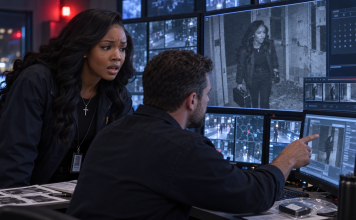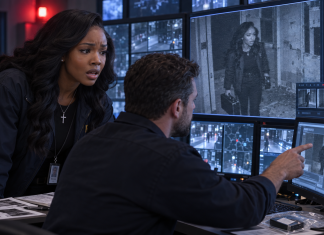
Sienna stopped beneath the flashing police lights when she saw the badge beside the covered victim.
Her own photograph stared back at her.
The name was identical. So was the identification number.
But Sienna’s real badge was still hanging around her neck.
The victim was identified as Mara Voss, a former federal credentials technician who had disappeared six months earlier. Detectives initially assumed the second badge was a sophisticated counterfeit created to frame Sienna.
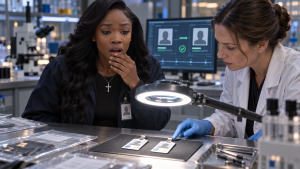
The forensic examination proved otherwise.
The metal, security seal and encrypted chip had all been manufactured inside an authorized federal facility. According to the official system, both badges were genuine.
Then the technician discovered something even more disturbing.
The badge recovered from Mara had been issued to “Agent Sienna Williams” eight years earlier—three years before Sienna joined the FBI.
Sienna searched the older personnel database, but every record connected to that identification number had been deleted. Only one reference remained: a sealed archive marked as a discontinued identity program.
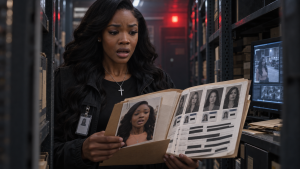
She entered the restricted records room alone.
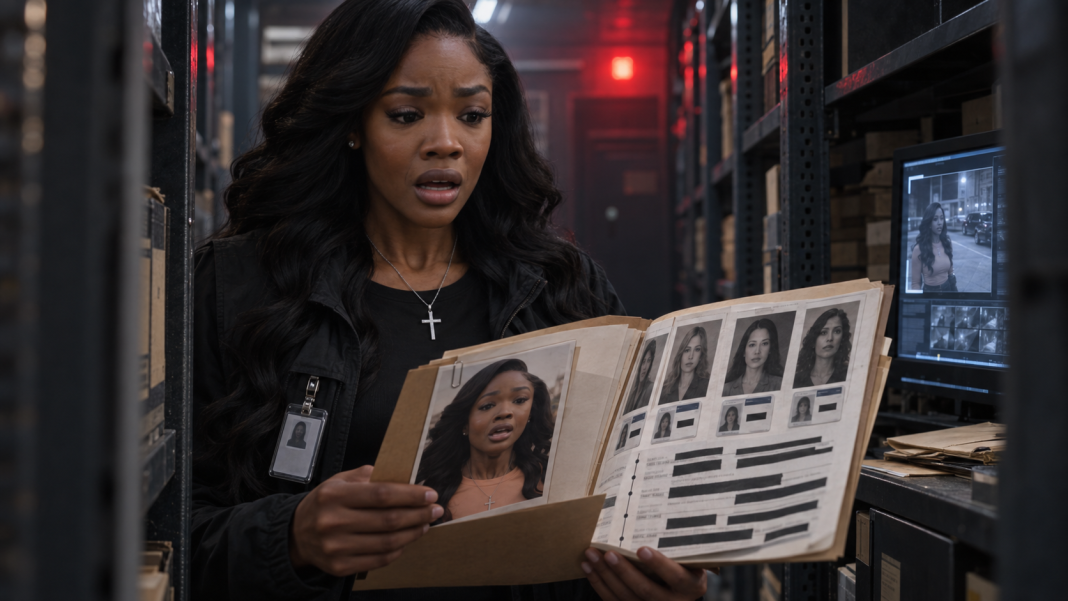
Inside, Sienna discovered four folders containing different women’s photographs. Each woman had served under the same name:
Sienna Williams.
It was not merely her identity. It was a manufactured federal alias that had been transferred between agents for nearly twenty years. The women were assigned to illegal operations that could never be connected to the Bureau.
Three of them disappeared after questioning their orders.
Mara had discovered the program while maintaining the badge system. Before she was killed, she copied its final records onto a hidden memory chip inside the recovered credential.
Sienna opened the encrypted files.
Her recruitment had not been accidental. The Bureau had monitored her since college, studied her family and deliberately placed her in situations designed to test her loyalty. Every major case she had worked was listed inside the program.
Beside her photograph were two words:
“OPERATOR FOUR.”
A final document had been approved that same evening:
“CURRENT IDENTITY COMPROMISED. REPLACEMENT AUTHORIZED. TERMINATION WINDOW: 48 HOURS.”
Suddenly, the archive terminal activated by itself.
A live security feed showed Sienna standing between the shelves. Someone was watching her through a camera hidden directly above her.
A message appeared on the screen:
“LEAVE THE BADGE AND WALK AWAY.”
The doors locked.
Sienna reached for her phone, but the recovered badge began flashing inside its evidence bag. It was transmitting her location.
That was when she understood the truth.
Mara had not been carrying the badge to impersonate Sienna.
She had taken it to warn her.
Footsteps approached from the other end of the archive.
Sienna turned toward the darkness as a woman’s voice calmly called her name.
Then the woman stepped into the red security light.
She was wearing another badge with Sienna’s photograph—and she had already been approved as Operator Five.