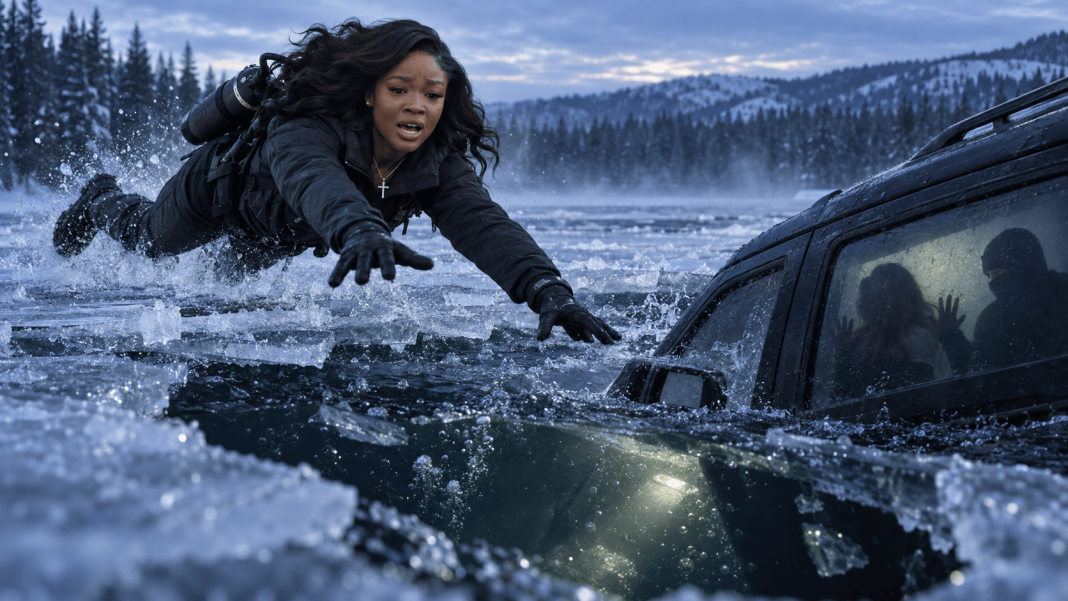
The SUV disappeared beneath the ice in less than ten seconds.
Sienna ran toward the opening as cracks spread beneath her boots. Through the black water, she could still see the vehicle’s headlights sinking into the darkness.
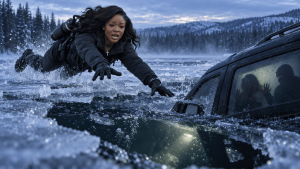
She secured her emergency oxygen regulator and jumped.
The cold hit like a wall. Sienna followed the bubbles downward until she reached the SUV. Inside, a terrified woman was trapped in the rear seat—but she wasn’t alone.
A masked man was holding her underwater.
Sienna shattered the weakened side window and forced herself into the flooded cabin. The man immediately grabbed her oxygen harness and tried to tear away her regulator. With almost no room to move, Sienna trapped his wrist, drove him into the front seat and used the open rear door to force him back.
She released the woman’s seat belt and pulled her through the broken window.
The SUV continued sinking beneath them.
Following her safety line, Sienna found the opening in the ice and pushed the woman onto the surface. Both of them were shaking violently. The stranger coughed, gasped and clung to Sienna’s arm as if she could barely remain conscious.
Then her behavior changed.
While Sienna looked back toward the submerged SUV, the woman slipped a waterproof phone from inside Sienna’s jacket.
It was a secure federal device protected by facial recognition.
The woman raised it toward her face.
The screen unlocked.
Sienna froze.
“They didn’t send me here to be rescued,” the woman said calmly. “They sent me to replace you.”
She pulled back her hood. Her face looked nothing like Sienna’s—but a small number had been marked on the side of her neck.
B7-14.
The same number appeared beneath the barcode on Sienna’s federal credential.
The phone suddenly opened a hidden file Sienna had never seen before: CONTINUITY ASSET 01.
According to the classified records, B7-14 was not a case number. It was Sienna’s original subject designation, assigned years before she joined the FBI.
The woman identified herself as Mara Voss. She had spent three years studying Sienna’s voice, movements, case history and psychological profile. She had access to Sienna’s apartment, vehicle, financial records—and every classified investigation she had ever opened.
But Mara wasn’t physically designed to look like her.
She didn’t need to be.
Someone inside the agency had secretly installed a secondary biometric profile on Sienna’s devices. When Mara looked at the phone, the system did not mistake her for Sienna. It recognized her as an authorized replacement.
The crash had been staged. The masked man was supposed to trap Sienna inside the SUV while Mara emerged from the lake carrying her phone and credentials. Everyone would believe Sienna had survived.
The real Sienna would remain beneath the ice.
“Who authorized this?” Sienna demanded.
Mara turned the phone toward her.
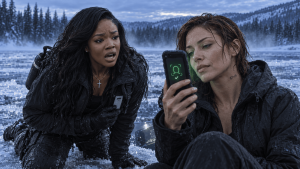
A classified authorization appeared on the screen. It was signed by Deputy Director Adrian Voss—Mara’s father and the man who had personally approved Sienna’s recruitment into the FBI.
The truth was worse than betrayal.
Voss had created the Continuity Program to replace agents who discovered operations that were never supposed to exist. Their replacements inherited their devices, access clearance and official identity. The original agents simply disappeared during missions.
Sienna grabbed Mara before she could escape and forced her onto the ice. But as she reached for the phone, it began ringing.
The caller ID displayed Sienna’s own name.
She answered.
A distorted voice said only four words:
“Replacement One has failed.”
Across the phone’s screen, seven new biometric profiles activated simultaneously.
Mara smiled despite being pinned beneath Sienna.
“You still don’t understand,” she whispered. “I wasn’t the only one they made.”
On the frozen road beyond the lake, headlights appeared between the trees.
Seven identical black vehicles were approaching.